New Method Will Enable More Accurate Measurement of Blood Sugar Levels
22. February 2022How is it possible to get an accurate result from a blood glucose test? This very matter has been tackled by scientists at the TBU’s Centre of Polymer Systems and the Footwear Research Centre, in cooperation with researchers from Pavol Jozef Šafárik University in Košice (UPJS). Accurately measuring a patient’s blood sugar level is critical in order to work out the right dose of insulin to be given.
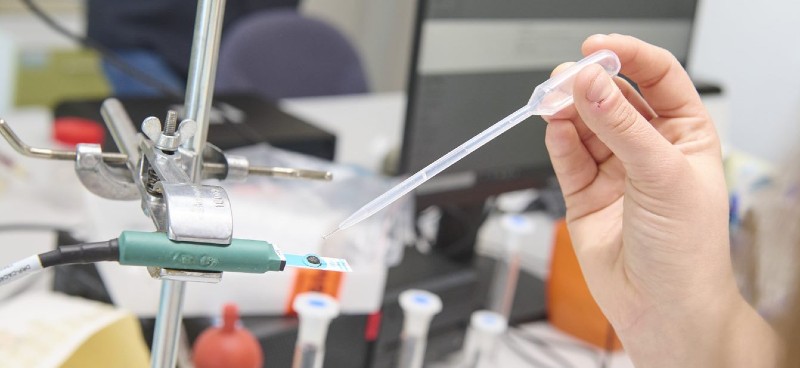
The scientists have investigated the surfaces of sensors for reading test strips in glucose meters (or glucometers) and developed a novel composite, which provides far more precise measurement of blood glucose (by up to 70%). Sensors featuring the new material are intended for electrochemical glucometers that gauge the amount of sugar in the blood according to a biochemical reaction induced by electricity.
“The new composite is based on chitosan polysaccharide, which has the ability to bind conductive metals. Having the right combination of these two components increases the response of electric current to the presence of glucose, facilitating extremely accurate measurement of blood sugar level,” describes Prof. Petr Sáha, guarantor and head of the Energy Materials and Composites group at the Centre of Polymer Systems.
“The current generation of glucometers function on the principle of oxidation of glucose in the presence of enzymes. However, enzymes are unstable, so the team has been trying to replace them with nanoparticles to gauge blood sugar or insulin more precisely. Replacing enzymes with nanoparticles could also significantly reduce the price of the sensors,” explains Prof. Renáta Oriňaková, a project investigator from the Department of Physical Chemistry of the Faculty of Science of the UPJS in Košice.
“Sensors developed in this manner will boast enhanced stability, accuracy and rapidity. They shall have a longer service life and lower demands on storage space,” adds Dr. Ivana Šišoláková, a member of the research team. Normal sensors last approximately six months, while the novel ones developed could be used for up to five years.
The principle behind the new method for measuring blood sugar has been protected by an application for a patent, which is being considered by the Industrial Property Office of the Czech Republic. Both universities involved are currently preparing various combinations of materials for sensors in such a manner as to achieve the greatest possible sensitivity to test strips. It is believed that testing of prototypes shall commence within a few months.