Seaweed as a Building Material and Cosmetic Ingredient: UTB Joins European SALINA Project
7. August 2026How can seaweed be used not just as food, but also as a raw material for construction, sports nutrition, or cosmetics? This is the question being addressed by a new European project called SALINA (Scalable Macroalgae Cultivation Systems for Innovative Applications), which the Faculty of Applied Informatics at Tomas Bata University in Zlín is joining. The project launched on June 1, 2026, will run for four years, and its lead investigator at UTB is Jiří Pecha from CEBIA-Tech, Faculty of Applied Informatics.
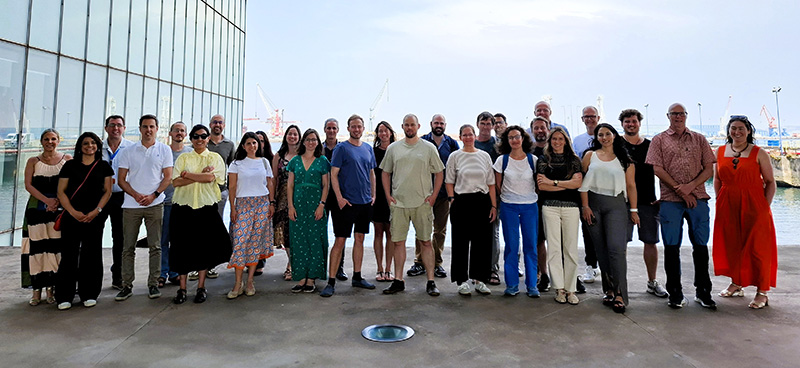
SALINA brings together 22 partners from 11 European countries to develop efficient, scalable methods for cultivating and processing seaweed. “The main idea behind the project is to develop new sustainable raw materials from renewable sources that can replace materials and ingredients derived from fossil-based sources in a range of applications. I see FAI UTB’s involvement in the SALINA project as a significant opportunity to develop our research activities further, and above all, to establish new international collaborations,” says Jiří Vojtěšek, Dean of FAI UTB.
The project focuses on the entire chain – from selecting suitable seaweed species and cultivating them, to processing the biomass and utilising its components. Various cultivation systems will be tested, both offshore and onshore, with four demonstration sites – in Ireland, the North Atlantic region, the Baltic Sea, and the Mediterranean – allowing the proposed methods to be tested under different conditions.
An important part of the project is the concept of cascading biorefining, which aims to make the best possible use of each part of the biomass while minimising waste. Seaweed can thus yield, for example, peptides and polysaccharides for functional beverages and sports nutrition, alginate for sustainable building materials, or functional ingredients for cosmetic creams and scrubs. The project also plans to develop food products, such as speciality snacks. All developed products and processes will subsequently be tested for safety, functionality, compliance with European legislation, and consumer acceptability.
For UTB, participation in the SALINA project represents, above all, an opportunity to develop new research directions and to pursue prestigious international collaborations in the fields of sustainable materials, biomass processing, and the use of renewable resources. “The project will allow us to combine our expertise with research and industrial partners from across Europe, while also drawing on our existing experience in biomass processing and the isolation of its valuable components. Our specific task will be to design and optimise technologies to isolate polysaccharides and proteins from seaweed to achieve high yields while maintaining the required purity. I believe our experience in this area will contribute significantly to the effective use of this biomass and its further processing into higher-value-added products. And, with a touch of tongue-in-cheek humour, one could say it’s great that we get to research seaweed even though the Czech Republic has no sea of its own,” says Jiří Pecha, the project’s lead investigator at FAI UTB. This is precisely the area that Jiří Pecha’s research group has long focused on, so the SALINA project builds naturally on its existing research activities.
At the same time, SALINA places strong emphasis on ensuring that sustainability claims are backed by robust scientific data. The project will therefore include a detailed Life Cycle Assessment (LCA), tracking factors such as energy consumption, resource efficiency, and the carbon footprint of individual processes – from seaweed cultivation through to the final product. The aim is to objectively assess the conditions under which seaweed-based products can genuinely represent a low-carbon, environmentally advantageous alternative to traditional fossil-based raw materials.
About the SALINA Project
The four-year SALINA project is funded under the Horizon Europe programme through the Circular Bio-based Europe Joint Undertaking (CBE JU). Its ambition is to validate new technologies under demonstration scale and to prepare them for scale-up to industrial production. For UTB, the project represents a further opportunity to connect research with the needs of European industry, develop international partnerships, and contribute to the development of new, more sustainable ways of using renewable biological resources. More information about the international SALINA project is available at salinaproject.eu.
About the Faculty of Applied Informatics, UTB in Zlín
The Faculty of Applied Informatics (FAI) at Tomas Bata University in Zlín was founded in 2006 with the mission of becoming a key driving force in applied innovation, modern technology education, and the transfer of knowledge into practice. FAI is a dynamic, modern faculty that sets the direction in the fields of artificial intelligence, automation, cybernetics, applied informatics, and security technologies. The faculty’s goal is to connect theoretical education with real-world impact on industry, society, and the career success of its students and graduates.