
Spanish Erasmus Students Win Sixth TBU Ideathon with Solutions for Zlín in the Event of a Blackout
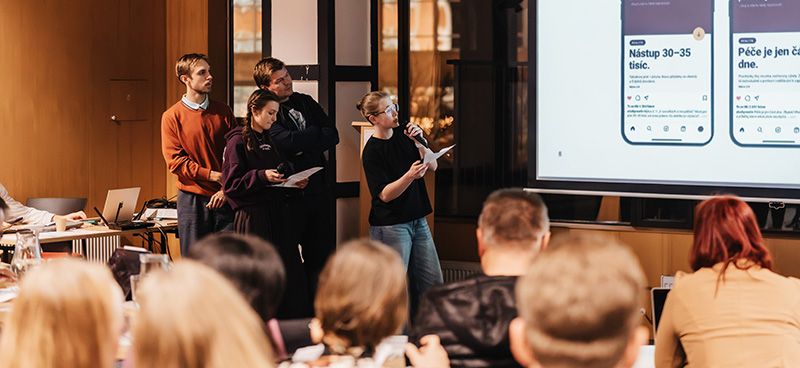
27. November 2026What does it take to rise to a real-world challenge? This was the question addressed by 46 students of Tomas Bata University in Zlín during the sixth edition of the TBU Ideathon, held on 24–25 November 2026 at the Technology Innovation Centre in Zlín. A total of 11 interdisciplinary teams presented 17 solutions to real-life challenges set by five organisations to a panel of expert judges. For the first time in the competition’s history, the overall winners were international students.
TBU Ideathon brings together students from different faculties across the University and gives them an opportunity to tackle real-world problems. Over the course of 24 hours, students work in interdisciplinary teams, discuss their ideas with experts and mentors, and then present their proposed solutions to a panel of judges.
This year’s competition featured five challenges in the fields of public administration, safety and security, social services, culture and community life. The Zlín Region was looking for a creative concept for the opening and closing ceremonies of the 2028 Children and Youth Olympics. The Municipality of Zlín, together with the Zlín Municipal Police, focused on finding effective ways to keep residents informed in emergency situations, including during outages of conventional communication networks. The MMAS of Uherské Hradiště sought new ways of developing community activities for young people, with a particular focus on their mental well-being. Social Services Vsetín explored how to attract and retain young people in the social care sector, while 14|15 BAŤA INSTITUTE was looking for new ways to make use of its outdoor platform and café.
A Language Barrier as a Challenge, Not an Obstacle
One of the highlights of this year’s event was the first-ever participation of a team of international Erasmus+ students. The three students from Spain – Marco Gálvez, Ainhoa García and Sergi Sansó – represented the Faculty of Management and Economics, the Faculty of Applied Informatics and the Faculty of Humanities, respectively. In doing so, they met one of the competition’s basic requirements: each team had to include students from at least three different faculties.
Although both the accompanying programme and the competition briefs were in Czech, the students decided to take on the challenge. They delivered their presentation in English, but prepared the presentation slides and accompanying materials in Czech to make it easier for the judges to understand their proposed solution.
Their determination, interdisciplinary teamwork and the quality of their final project ultimately earned them the overall victory.