

Tomas Bata University in Zlín Celebrates 25 Years
9. February 2026This year, Tomas Bata University in Zlín (TBU) celebrates the 25th anniversary of its establishment. Since 1 January 2001, the University has come a long way. Today, it is an integral part of Zlín and Uherské Hradiště, a key driver of development in the Zlín Region, and an important centre of education, research and cooperation not only within the Czech Republic and Europe, but in certain fields worldwide. The anniversary will be marked throughout the year by a series of events for students, employees and the general public.
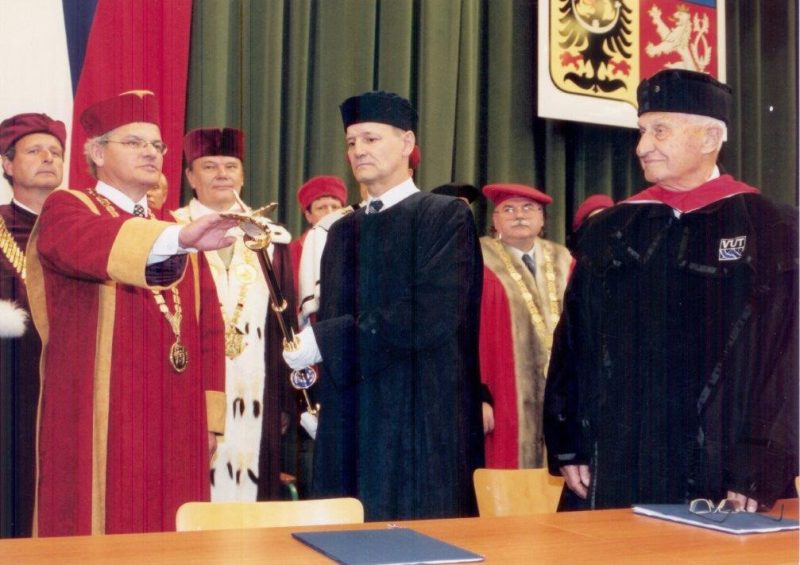
The establishment of the university in Zlín dates back to 1 January 2001. The new institution was created by separating the Faculty of Technology (FT) and the Faculty of Management and Economics (FaME) from Brno University of Technology (BUT). The decisive moment came on 14 November 2000, when President Václav Havel signed the Act on the Establishment of Tomas Bata University in Zlín, enabling the University to officially commence its activities on 1 January 2001. The ceremonial inauguration of the University and its first Rector, Professor Petr Sáha, CSc., took place on 16 May 2001.
A great honour for the newly established university was the consent of Tomas J. Bata (1914–2008) for the institution to bear the name of his father, the founder of the world-renowned footwear empire (1876–1932). Tomas J. Bata became the first Chair of the TBU’s Board of Governors and instilled in the University the vision of educating graduates for the global labour market.
In the years that followed, Zlín experienced an unprecedented construction and scientific boom. The University expanded rapidly with the establishment of the Faculty of Multimedia Communications (2002), the Faculty of Applied Informatics (2006), and the Faculty of Humanities (2007). Its institutional structure was completed in 2009 with the founding of the Faculty of Logistics and Crisis Management, based in Uherské Hradiště. Over the years, the University has continuously broadened its range of degree programmes in line with societal needs. Today, it offers higher education in technical, economic, IT, humanities, artistic and health-related disciplines. Prospective students can choose from approximately 90 degree programmes at Bachelor’s, Master’s and doctoral levels, 68 of which are taught in English. Studies are offered in both full-time and part-time modes. Long-term emphasis is also placed on the development of lifelong learning programmes, including the University of the Third Age, as well as on support for students with specific needs.

At present, TBU has around 10,000 students, approximately 13% of whom come from abroad. At the same time, the University ranks among the largest employers in the Zlín Region, with around 1,100 employees.
One of the University’s greatest assets is undoubtedly its research centres, which rank among leading international facilities. These include, in particular, the Centre of Polymer Systems (CPS), focusing on polymer processing, environmental technologies, rubber technologies, nanomaterials, biomaterials, and energy and composite materials. Another key research facility is the Centre for Security, Information and Advanced Technologies (CEBIA-Tech), which specialises in research and development in applied informatics, security technologies and alternative energy sources. Together with the Footwear Research Centre, these units have achieved significant long-term results. In line with the profiles of its faculties, TBU also hosts six additional research centres. The TBU University Institute, among other activities, ensures technology transfer into practice, intellectual property protection and cooperation with industry.
Since its foundation, TBU has been a strongly internationally oriented institution, systematically building international cooperation in research, education and mobility. It has established a network of more than 300 partner institutions worldwide, and opportunities for study and work placements abroad continue to expand for both students and academic staff, within Europe and beyond. The University is involved in major international projects funded by the EU and is also a member of the PIONEER European Universities Alliance, supported by the European Commission, which opens up new international opportunities. Holding the status of a European University means that TBU is an active partner in the European education and research area.
Over the past 25 years, the University has constructed or renovated a number of buildings to ensure the necessary infrastructure for teaching and research. This has included the development of the Faculty of Applied Informatics campus in the Jižní Svahy area of Zlín (2002–2004), the construction of the University Centre, which houses the Library (2008), also the new building of the Centre of Polymer Systems (2015), and the Educational Complex (home of the Faculty of Humanities, 2017). Thanks to the University, world-renowned architect Professor Eva Jiřičná returned to her hometown of Zlín and designed, among other projects, the University Centre, the Educational Complex and the reconstruction of the TBU Assembly Hall.
In addition, the University has invested over the years in excellent technological equipment, including machinery and specialised instruments essential for its activities. Recently, a number of investments have been completed or prepared to improve facilities for study and everyday life for students and staff – ranging from the renovation of student residences and the canteen to the construction of a new building for the Faculty of Technology, which is currently at an advanced stage of implementation. These projects confirm the University’s long-term commitment to creating a modern, high-quality and functional study and working environment. An important role in the University’s current development is played by cooperation with the Zlín Region and other partners, which continues to deepen. Joint activities are reflected not only in investment projects but also in the creation of new degree programmes. Programmes such as Paramedicine, Radiography, Home and Hospice Care, as well as a planned programme focused on educating experts in semiconductor materials, respond to current regional needs and the demands of today’s society creating a modern, high-quality and functional study and working environment.
The University has repeatedly demonstrated its ability to face demanding social and institutional challenges and to respond flexibly to situations that significantly affect academic life. The Covid-19 pandemic, for example, had a major impact on the form of teaching, limiting instruction in laboratories, studios and lecture halls. Shortly afterwards, TBU became involved in providing assistance to people affected by the war in Ukraine and supported Ukrainian students, many of whom became part of its academic community. Together with other higher education institutions in the Czech Republic, TBU has also had to respond to new security and societal challenges.
Celebrations as an Opportunity to Meet
The 25th anniversary of the University’s establishment is not only a reminder of its history, but above all an opportunity to come together. Throughout the year, a wide range of events will take place, offering space for sharing memories and experiences as well as for informal celebrations across the University community.
Tomas Bata University in Zlín thus enters the next stage of its existence as a stable institution, firmly rooted in the Czech Republic and Europe, while remaining ready to respond to the challenges of the future.
Selected Events Marking the 25th Anniversary of TBU:
- 20 February 2026 | TBU Gala Ball
- 25 March 2026 | Festive Gathering of the Academic Community
- 24 April 2026 | Doctoral Graduation Ceremony
- 20–24 April 2026 | International Week
- 23 April 2026 | Rector’s Sports Day (Swimming Relay)
- 7 May 2026 | TBU Rag Day
- 21–25. September 2026 | ESDW Festival
- 25. September 2026 | Science Night
- 19. November 2026 | Concert for Employees