
2. Unlocking mobile devices
The individual methods used to unlock mobile devices vary in reliability. Which ones are more reliable?
Did it happen?
Markéta is 34 years old and holds the position of head of the international relations department of an unnamed ministry. She was given a company mobile phone for work purposes. When she first turned on the phone, she was asked to choose a method to unlock the phone. She chose the gesture method, where she had to connect several dots on the display in the correct order. She was used to this method from her private phone. One day, Markéta was shocked. She discovered that many contacts had disappeared from the list and that several strange SMS messages had been sent from her phone. It later turned out that the phone had fallen into the hands of children who were playing over the weekend. They managed to unlock it. They thought it was a game.
Unlocking mobile devices
We should not underestimate the unlocking settings of mobile devices. In the event of loss or theft of a mobile phone or tablet, we will be glad that it is locked using one of the available methods. A locked device will give us time to act in crisis situations. Company mobile devices can be protected by a loss insurance policy that allows them to be traced or managed remotely, erased, etc. Older mobile devices allowed the user to not set any lock and the device was always unlocked. However, this is a gross mistake that exposes our accounts, emails or calendars. So how do you lock a device?
Evaluation of traditional unlocking methods
This includes a PIN (numeric code) and a gesture (connecting dots on the display). In order for the PIN to protect the device well, it must not consist of less than 6 digits and must not be a trivial sequence (111111, 123456, etc.). Today’s devices automatically prevent trivial sequences and warn that they are weak. Guessing a sequence of 6 digits in the correct combination is difficult, and the digits are usually represented by a dot. If the above conditions are met, a PIN is a good method of unlocking. In contrast, a gesture, where we connect the dots on the display in the correct order, is considered the least secure method. Why? Because it is not covered by anything and is easy to guess. It is curious that the gesture of both right-handed and left-handed people usually starts in the upper left corner. Moreover, every tenth user chooses a letter as a pattern. And there are not many convenient combinations.
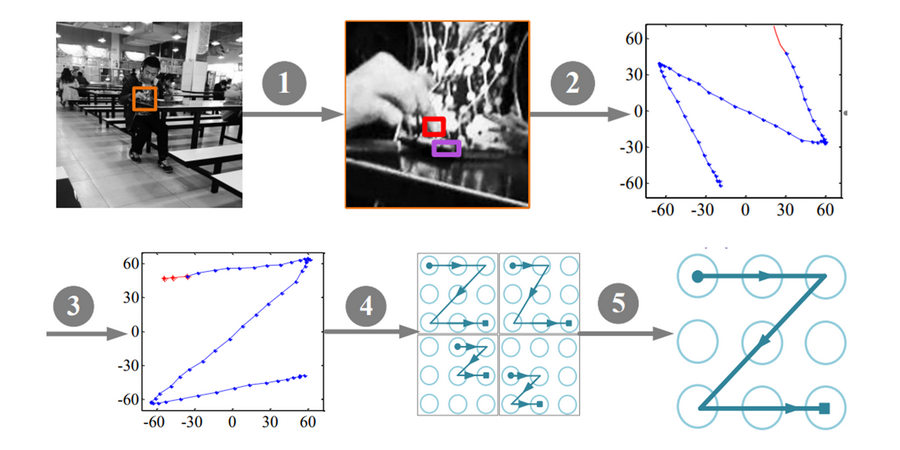
The illustration shows the procedure used to obtain the unlocking pattern in the experiment. 1) video recording of the user, 2) selection of the monitored area, 3) analysis of the direction and path of the finger, 4) rotation of the path from the user’s perspective, 5) probable results, 6) correct result.
Source: eprints.whiterose.ac.uk/151222/
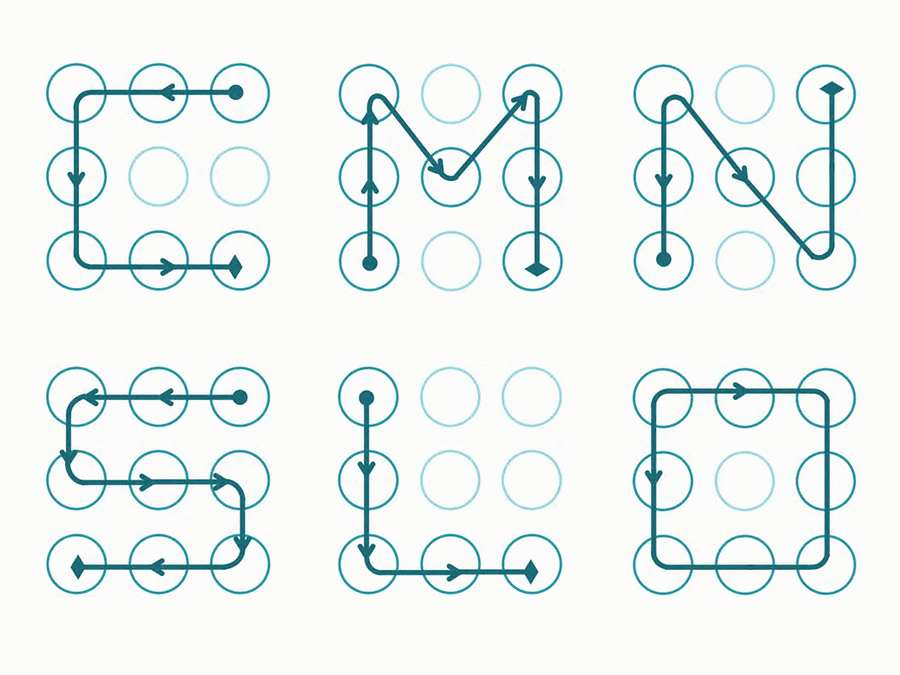
The illustrative image shows probably the most commonly used patterns for unlocking a mobile device.
Probable source: eprints.whiterose.ac.uk/151222/
Evaluation of modern unlocking methods
This includes fingerprint and face scan unlocking. Modern unlocking methods work differently, depending on the manufacturer’s technology and the price category of the device. There are known cases where these methods were outsmarted by a user’s photo or wax fingerprint. However, they are experiencing rapid development. For example, comparing a 2D photographic scan of a face with a stored photo of the user has long been out of fashion. 3D scanners with an infrared sensor are emerging, which create a depth map of the face. They calculate how the infrared beam reflects off the face and compare the depth map of the face with the scanned one. The infrared sensor also solves previous problems with functioning in poor lighting conditions. Fingerprint scanners have undergone similar development. Advanced scanners do not simply track a fingerprint, but store its electrical charge in memory. From the electrical charge, they calculate whether it is the user’s fingerprint or someone else’s.
So what unlocking method do you recommend?
It is important to note that modern unlocking methods use traditional unlocking methods as a backup. Even the best fingerprint or face scanners will not protect the user if a weak PIN or weak gesture is selected as a backup. The most suitable unlocking method seems to be some modern method with a carefully selected PIN.
Pocket puller
| 1. PIN | 2. “Gesture” | 3. Fingerprint | 4. Face scan |
| A PIN is a good method for unlocking mobile devices. To provide good protection, it should consist of at least six digits and not a trivial sequence like 123456. Today’s devices often warn you about this. | The method of connecting dots on the screen into a pattern doesn’t have a very good reputation. There are few convenient combinations, people choose capital letters as a pattern, for example, and someone can peek at the pattern. | Fingerprint is a good method for unlocking mobile devices. Modern readers no longer track the fingerprint as such, but its electrical charge. That is why they are very reliable. They work best together with a strong PIN. | When the method was new, it was sometimes outsmarted. But it has evolved. It depends on the type of device and scanner, but the reliability of the method is high today. It also works best with a strong PIN. |